thumbnail image

The English Convent

  • Home
  • Our Community
  • History
  • Concerts at the English Convent
  • Joseph Ryelandt
  • Christian Meditation
  • Visit and guided tours
  • Celebrations
  • Contact
  • …  
    • Home
    • Our Community
    • History
    • Concerts at the English Convent
    • Joseph Ryelandt
    • Christian Meditation
    • Visit and guided tours
    • Celebrations
    • Contact

    The English Convent

    • Home
    • Our Community
    • History
    • Concerts at the English Convent
    • Joseph Ryelandt
    • Christian Meditation
    • Visit and guided tours
    • Celebrations
    • Contact
    • …  
      • Home
      • Our Community
      • History
      • Concerts at the English Convent
      • Joseph Ryelandt
      • Christian Meditation
      • Visit and guided tours
      • Celebrations
      • Contact
      • History

        Huize Nazareth

        Huize Nazareth

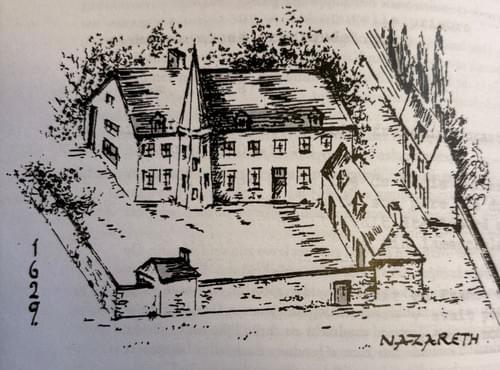
        The English Convent, officially the Nazareth Priory of the English Canons Regular of St Augustine, was founded in 1629 when a group of English Augustinian nuns from Leuven settled in Bruges in the former Nazareth guesthouse. This gave rise to a convent for English nuns in exile, who had fled the persecutions under Henry VIII.

        From around 1647, various buildings were erected for the convent, and by around 1650 a fully-fledged complex had been established thanks to local support.


        In the 18th century, the complex underwent significant construction and extension works. Between 1736 and 1739, the striking domed church was built to a design by architect Hendrik Pulinx, later artistically embellished in the 19th century.


        During the 19th century, the monastery developed into a renowned educational centre with a boarding school: initially mainly for English girls, and later also for Belgian and other nationalities. The Flemish priest and poet Guido Gezelle served for a time as rector and teacher at the school.

        Modern Devotion and Geert Grote

        Modern Devotion and Geert Grote

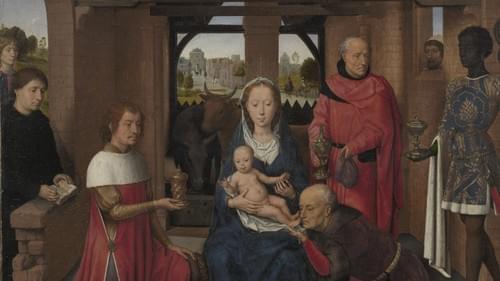
        The 14th century was a time of turmoil and division within the Church and society. It was during this period that Geert Groote (1340–1384) came to the fore. Born in Deventer in the Netherlands, he was an outstanding student, first in Paris and later in Cologne. A man of the world who was converted by the vision of a friend.
        He was clearly aware of the fact that any renewal must begin with a personal inner life centred on Christ.
        Thus he set out to spread an ideal: a return to the Vita Apostolica, of which the Gospel is the foundation and the rule – a spiritual movement known as Modern Devotion.
        Modern Devotion simply means ‘contemporary spirituality’. In the late fourteenth century, there was a sense that the Christian way of life of that time was no longer sufficient. A deeper, personal encounter with Christ was needed to breathe new life into the lives of laypeople, priests and monastics in the Church of that era. Outward rituals alone were not enough. That is why Geert Grote began to emphasise turning inward into the silence of the heart, where Christ dwells.
        The Congregation of Windesheim and the English Convent

        The Congregation of Windesheim and the English Convent

        One of the most characteristic works of the Modern Devotion movement is *The Imitation of Christ* by Thomas à Kempis. This work consists of four treatises and takes the reader on a journey: first towards detachment, then towards an intimate conversation with Christ as with a friend, then towards participating in his self-giving (through the Eucharist), and thus ultimately towards the mystical experience of His gracious presence. Ultimately, it is about following Christ in daily life.
        The Congregation of Windesheim was founded in 1387 when six Brothers took their vows as Canons Regular on the 17th of October. Windesheim means ‘House of the Wind’. The congregation arose from the Modern Devotion movement and adopted the Rule of St Augustine.

        Around 1381, Geert Grote visited the Flemish mystic Jan van Ruusbroec in the Sonian Forest. The community that arose there later joined the Congregation of Windesheim. The sisters of the English Convent learnt from Ruusbroec that love is ‘inner and outer’, meaning that one must journey to the deepest core of one’s being to encounter Love there and then carry it out into the world.
        Thomas More

        Thomas More

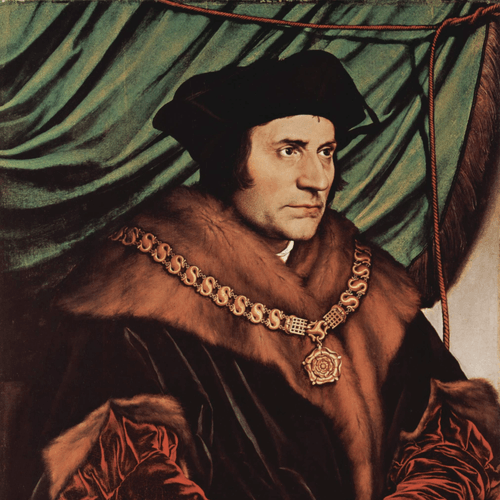
        Thomas More, the English statesman, humanist and saint, has strong ties to the English Monastery. A relic of Thomas More is kept in the chapel, lending the monastery a special spiritual significance. Furthermore, his descendants played a remarkable role in the history of the monastery: a female descendant of Thomas More (the daughter of his adopted daughter) entered the monastery and became prioress. She stood at the head of the community and contributed to the continuity, governance and religious life of the English Convent. Thus, the legacy of Thomas More lives on not only in a relic, but also in his family’s involvement with this unique Bruges monastic community.
        The turmoil of the French Revolution

        The turmoil of the French Revolution

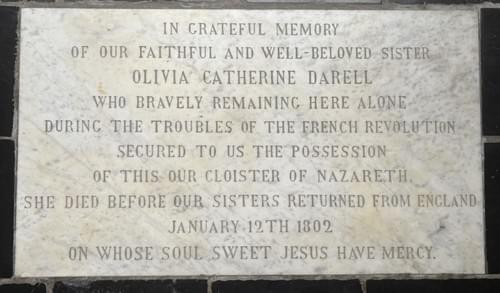
        During the French Revolution, the sisters fled to England, leaving the convent in the care of Sister Olivia Catherine Darell.
        She bravely remained behind with a few fellow sisters who were no longer able to travel. When the French forced her to sell the convent, she handled the situation ingeniously.

        She sold it to a notary friend, who in turn sold it back to the sisters once calm had been restored. Sadly, however, Sister Olivia did not live to see the return of her fellow sisters, as she passed away shortly before. This memorial stone commemorates her courage and perseverance for future generations.
        Guido Gezelle and the English Convent

        Guido Gezelle and the English Convent

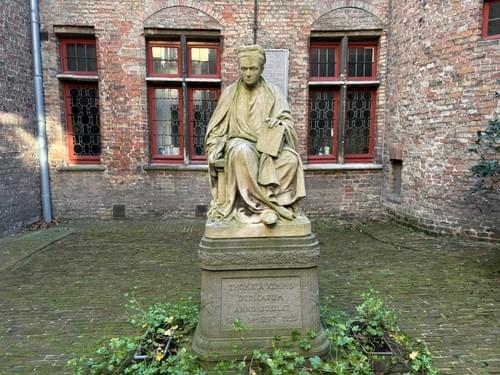
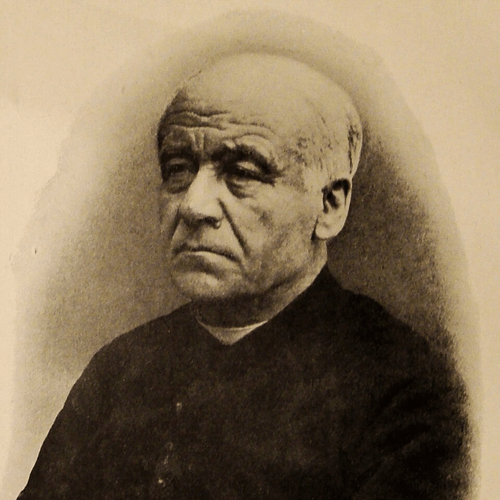
        Guido Gezelle, one of the greatest Flemish poets, had close ties to the English Monastery. He served as its rector and taught there as well. The peaceful monastic setting provided him with the space for study, reflection and creativity. It was here that he wrote several of his poems, in which his love of nature and his subtle sense of language are clearly evident. Gezelle spent the final months of his life at the monastery and died there in 1899, making the English Monastery an important place of remembrance for his life and work. His last words were ‘I loved to hear the little birds chirping’.
        Library and Archives

        Library and Archives

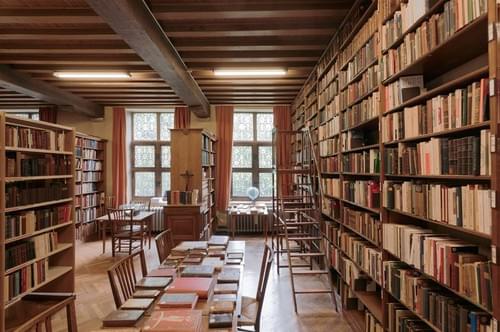
        We have an extensive library and an archive. These may be consulted by appointment for research and study. Please contact the monastery on the number below: 050/33.24.24
        Start
        Berichten
        Vind ons
        Contact
      Cookie Use
      We use cookies to ensure a smooth browsing experience. By continuing we assume you accept the use of cookies.
      Learn More